


Book of Common Prayer and Whole Book of Psalms 1583
Couldn't load pickup availability
6B Book of Common Prayer. London: Christopher Barker, 1583. Bound with The Whole book of Psalms. London: John Daye, 1583.
Description
The Book of Common Prayer is the foundational liturgical text of the Church of England, setting out the forms of worship used in public services and private devotion, including daily prayers, the Eucharist, baptism, marriage, funerals, and the church calendar. Compiled to create a unified and accessible form of worship in English, it played a central role in shaping Anglican theology, language, and religious practice, and its prose has had a lasting influence on English literature and spiritual life well beyond the church itself.
The Book of Psalms is a collection of 150 poetic prayers and hymns found in the Old Testament, traditionally attributed in part to King David and long used in Jewish and Christian worship. Covering a wide range of human experience—praise, lament, thanksgiving, repentance, and hope—the Psalms have been central to both personal devotion and communal liturgy for thousands of years. Their poetic language, emotional depth, and adaptability to music have made them some of the most frequently read, memorized, and sung passages of the Bible.
Versions printed in the 1500s reflect the turbulent religious changes of the English Reformation. The first Book of Common Prayer was published in 1549 under Archbishop Thomas Cranmer during the reign of Edward VI, marking a decisive move away from Latin toward English worship. A more explicitly Protestant revision followed in 1552, altering theology and ceremonial practices. Under Mary I, these editions were suppressed in favor of Catholic liturgy, but the Prayer Book was restored and revised again in 1559 under Elizabeth I, forming the basis of Anglican worship for generations. These 16th-century printings were closely tied to royal authority, and their wording and distribution were matters of both religious and political significance.
Notes
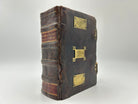
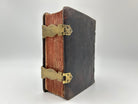
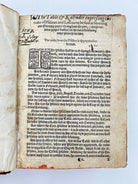
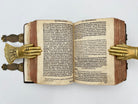
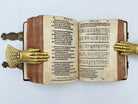
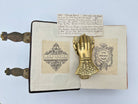
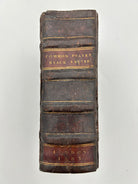
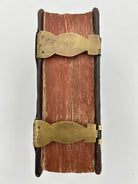
Deep brown Calf with brass clasps, rebacked with original spine laid down, four raised bands, red morocco labels (added later) lettered in gilt. Lacking title page. On the upper cover are three raised brass plates, the central plate engraved with the name Merewether which is also, as noted, inscribed on the on the title page for the Psalms in the Prayer Book. Twentieth century endpapers with bookplates of Albert Thorndike and the Zion Research Library. A very good copy, in a lovely, unsophisticated binding, of a rare edition of the Elizabethan prayer book from early in the career of the Barker family.