




Bishops’ Bible 1585
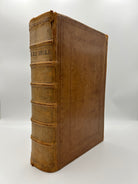
6B Bishop’s Bible, First Authorized English Translation of the Bible under the reign of Queen Elizabeth I. London: Christoper Barker 1585.
Notes
The Bishops’ Bible emerged from the unsettled landscape of English Bible translation in the mid-16th century, following decades of rapid religious and political change. After William Tyndale’s pioneering English translations in the 1520s and 1530s—most of which were printed on the Continent and condemned in England—the Great Bible of 1539 became the first officially authorized English Bible, produced under Henry VIII and printed primarily by Richard Grafton and Edward Whitchurch. Although monumental and publicly displayed in churches, the Great Bible was based on earlier translations and was textually uneven. During the reign of Mary I (1553–1558), Protestant Bible printing in England largely ceased, while many English reformers fled abroad and used the Geneva Bible (first published in 1560), a smaller, scholarly, Calvinist-leaning translation printed outside England and filled with marginal notes critical of monarchy and episcopal authority.
When Elizabeth I ascended the throne in 1558, the Geneva Bible quickly became popular among lay readers, but its marginal notes were deeply troubling to church and crown authorities. In response, the English episcopate proposed a new translation that would be doctrinally moderate, free of controversial commentary, and suitable for official church use. This effort produced the Bishops’ Bible, so named because much of the translation work was assigned to bishops and senior clergy, including Matthew Parker, Archbishop of Canterbury, who oversaw the project. Rather than creating an entirely new translation from scratch, the Bishops’ Bible revised earlier English versions—especially the Great Bible—while consulting Hebrew, Greek, and Latin sources, as well as continental Protestant scholarship.
Description
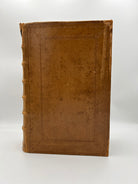
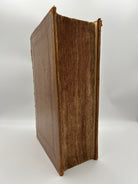
Caramel leather boards with embossed detailing on boards and spine. Six raised bands on the spine with embossed lettering. Slight tearing to the upper and lower spine with rubbing down of the leather along the edges and raised bands. Browning to interior pages, bookworm holes on several leaves. Scuffing along the boards. Fine condition overall.